

Training & Knowledge Transfer Service
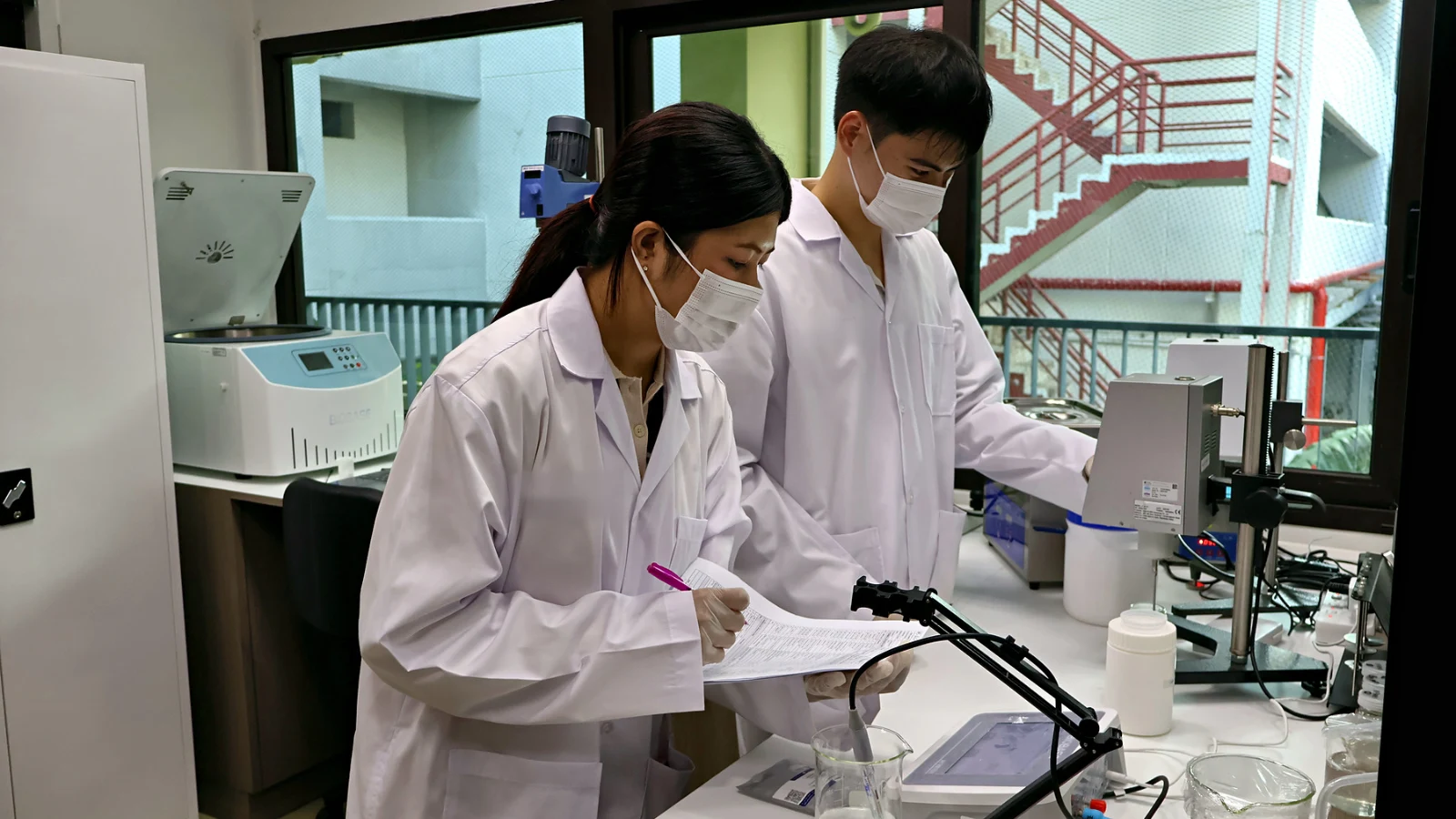
Helping your team talk to manufacturers with real understanding
The cost of not knowing
Having worked with clients for some time, we have noticed a recurring pattern.
A brand’s purchasing team chooses suppliers on price per kilogram alone, because they do not know they should also look at the active compound percentage and the analytical method. The result is buying something that looks cheap but costs more per unit of active compound.
The marketing team writes label text that goes beyond what the law allows, because they do not know where the line is, and the whole batch of labels has to be reprinted.
The product development team chooses an extract that is incompatible with the product format, and then finds it precipitates after production.
Farmers in the network dry herbs in a way that causes microbial tests to fail, even though it could be fixed with only a small change in method.
All of these problems have one thing in common: they can be solved with knowledge that can be passed on in just a few hours, yet the cost of not knowing runs from hundreds of thousands to millions of baht each time.
The courses we offer
Course for purchasing teams: reading documents and choosing suppliers properly
Content covers reading a certificate of analysis line by line, understanding why figures from different suppliers cannot be compared directly, calculating price per unit of active compound instead of price per kilogram, the documents to request from suppliers, and the questions to ask before deciding.
This course usually delivers the fastest return, because the team can apply it straight away to the quotations already on the desk.
Course for product development teams: choosing compounds and designing compatible formulas
Content covers the properties of each extract group, compatibility with each product format, common problems with solubility, stability, taste and colour, how to prevent them at the compound selection stage, and how to calculate backwards from the raw material budget per unit.
Course for marketing teams: communicating powerfully without breaking the law
This has been the most popular course recently. Content covers the legal framework for each product category (Notification of the Ministry of Public Health No. 293 B.E. 2548, 2006; Cosmetic Act B.E. 2558, 2015; Herbal Products Act B.E. 2562, 2019), the difference between stating process facts and making efficacy claims, how to use research data correctly, and writing that is strong enough to sell without crossing the line.
Course for farmers and community enterprises: post-harvest handling that earns a good price
Content covers the right harvest timing, sun-drying and oven-drying methods that pass testing, storage that prevents mould, the records buyers require, and the quality criteria manufacturers use to decide whether to buy (World Health Organization, 2003).
We offer this course at a special price for farmer groups, because it is an investment in upstream raw material quality that benefits the whole industry.
Course for executives: understanding the value chain as a whole
The content gives a broad picture of how the extract industry works, where the costs lie, where differentiation can be created and where to invest first. It suits executives who need to make investment decisions without going into technical detail.
Training formats
In-house training Held at your premises, with content tailored to your products and the team’s real problems. This is the most effective format because it uses case studies from the work the team is actually doing.

Hands-on training at our facility We bring your team to see the actual processes and carry out some steps themselves, which builds an understanding of process limitations that sitting through a lecture cannot. It suits product development and purchasing teams.
Open group training For small businesses without a team large enough for in-house training, several companies are combined in a single session.
Ongoing consultation after training For organisations that want the knowledge to really take root, we offer follow-up and question answering over an agreed period, because knowledge from a single training session is often lost if it is not used immediately.
What makes our courses different from reading on your own
Most of what we teach can be found in textbooks and on the internet. What we add is three things.
The Thai market context The criteria and requirements actually used in Thailand, the prices at which materials are actually traded, and the problems Thai businesses frequently face, which differ from foreign textbooks.
Case studies from real work We share real cases without naming clients, both successes and failures. Seeing where others went wrong is usually remembered better than hearing principles.
Answers that match the learners’ work Because we know what problems the team is currently facing, we can go into detail on exactly those points.
What you need to prepare
The number of participants and each person’s role; the topics you want to focus on, or let us propose them from the problems you describe; the products or projects the team is working on, to use as case studies; and the time you can allocate.
If you have real documents the team is using, such as certificates of analysis from suppliers or labels being designed, send them to us in advance. We will use them as teaching examples, which helps participants see the point immediately.
What you will receive
Training according to the agreed course, supporting materials the team can keep for reference, practical tools such as a document review checklist, a price-per-unit-of-active-compound calculation sheet and a list of questions to ask suppliers, plus a channel for further questions during an agreed period.

What happens after training, and how to stop the knowledge fading
The usual problem with training is that participants understand on the day, then forget within a few weeks because they do not use it.
We have designed three things to address this.
Tools that can be used the very next day Not just slides, but a document review checklist, a price-per-unit-of-active-compound calculation sheet and a list of questions to ask suppliers, which the team can apply to real work straight away.
Using the team’s real documents as case studies Instead of hypothetical examples, we ask for the documents the team is currently working on and teach with them, so what is learned is tied to real work from day one.
A channel for follow-up questions after training Because the most valuable questions usually arise when doing the work, not while listening, we set out in our proposal a period during which the team can come back with questions.
Why we teach buyers to get better at evaluating manufacturers
People ask why a manufacturer would teach its customers to get better at evaluating manufacturers, which sounds contrary to its own interests.

The answer is that a market where buyers cannot tell good products from bad is a market where careless operators have the advantage, because they cut costs where nobody checks and then offer lower prices.
Conversely, a market where buyers know what to look for is a market where investing in quality and documentation pays off.
So we see making buyers in the market more knowledgeable as a long-term investment in the arena we want to compete in, rather than as handing weapons to the other side.
How to choose a course that matches what your team actually lacks
A common problem when companies arrange training is choosing topics because they sound important, rather than because of what is actually holding up the work. The result is that the team gains knowledge it does not yet use, while the original problems stay where they were. So we start every project by finding the real bottleneck before proposing a course.
An approach that works is to look back at three things. The first is the list of problems that have recurred over the past six months. If most of them are raw material batches failing specifications, the course needed is on receiving inspection and reading documents, not advanced extraction technology. The second is the questions the team asks its supervisors most often, because repeated questions are the clearest knowledge gaps. The third is the points where work has to wait for one person’s decision, which usually means knowledge is concentrated in that person and should be passed on.
Once the bottleneck is known, choosing the course level becomes easier. Purchasing and marketing teams need knowledge at the level of reading documents and asking the right questions; they do not need to understand the chemical mechanisms. Production and quality assurance teams need a deeper level because they have to make decisions on the shop floor. Training all teams together with a single set of content therefore often leaves one group bored and another unable to keep up.
Another factor that strongly shapes the outcome is timing. Training held when the team is about to need that knowledge within the next month delivers incomparably different results from training scheduled half a year in advance. We therefore usually recommend tying the training schedule to the actual work plan, for example running the registration documents session before starting a project that actually has to be submitted, rather than holding it as an annual event.
Finally, define before the training what will signal that it has worked. A good indicator is not a post-course test score but something that changes in day-to-day work, such as fewer documents being sent back for correction, or less time taken to decide whether to accept a raw material.
Frequently asked questions (FAQ)
Q: Our team has no science background at all. Can they still take part?
A: Yes, and this is the group we have designed our courses for. The content focuses on practical use rather than theory, and we do not use technical terms without explaining them.
Q: How many hours is the training?
A: From half a day to several days, depending on the course and the depth required. We propose a time structure along with our proposal.
Q: Is training only for clients who buy extracts from Zubb Biotech?
A: No. It is open to all organisations, including manufacturers that work with other producers, because we believe a market where buyers are more knowledgeable is a market where manufacturers who do good work have the advantage.
Q: Is there a training certificate?
A: There is a certificate of attendance for every participant. For organisations that need documentation for their quality system, we prepare training records in a usable format.
Q: Can you teach a specific technical topic we need?
A: Yes. We design courses to your requirements, whether you want to go deep into one particular topic or want a broad overview.
Q: Can you run training for our farmer network?
A: Yes, and it is a service we particularly support, because upstream raw material quality benefits the whole industry. We have special pricing for training farmer groups and community enterprises.
Next step
Tell us what problems your team is facing at [email protected] or LINE @zubbbiotech. We will propose a course that matches those problems, with a time structure and price range, as quickly as possible. If you are not yet sure which course you need, just describe your situation and we will help you assess it.
Contact us and request a quotation
Send us the details of your project via Contact us or LINE @zubbbiotech · Tel. +66 89 056 5651 · +66 97 297 1777 · Email [email protected]
References
- Notification of the Ministry of Public Health (No. 293) B.E. 2548 Re: Dietary supplements, as amended. (2006, February 2). Royal Thai Government Gazette, 123(Special Part 18 Ngor).
- Herbal Products Act B.E. 2562. (2019, April 30). Royal Thai Government Gazette, 136(Part 56 Kor), 1–29.
- Cosmetic Act B.E. 2558. (2015, September 8). Royal Thai Government Gazette, 132(Part 86 Kor), 5–28.
- World Health Organization. (2003). WHO guidelines on good agricultural and collection practices (GACP) for medicinal plants.