

Private Label Ingredient Service
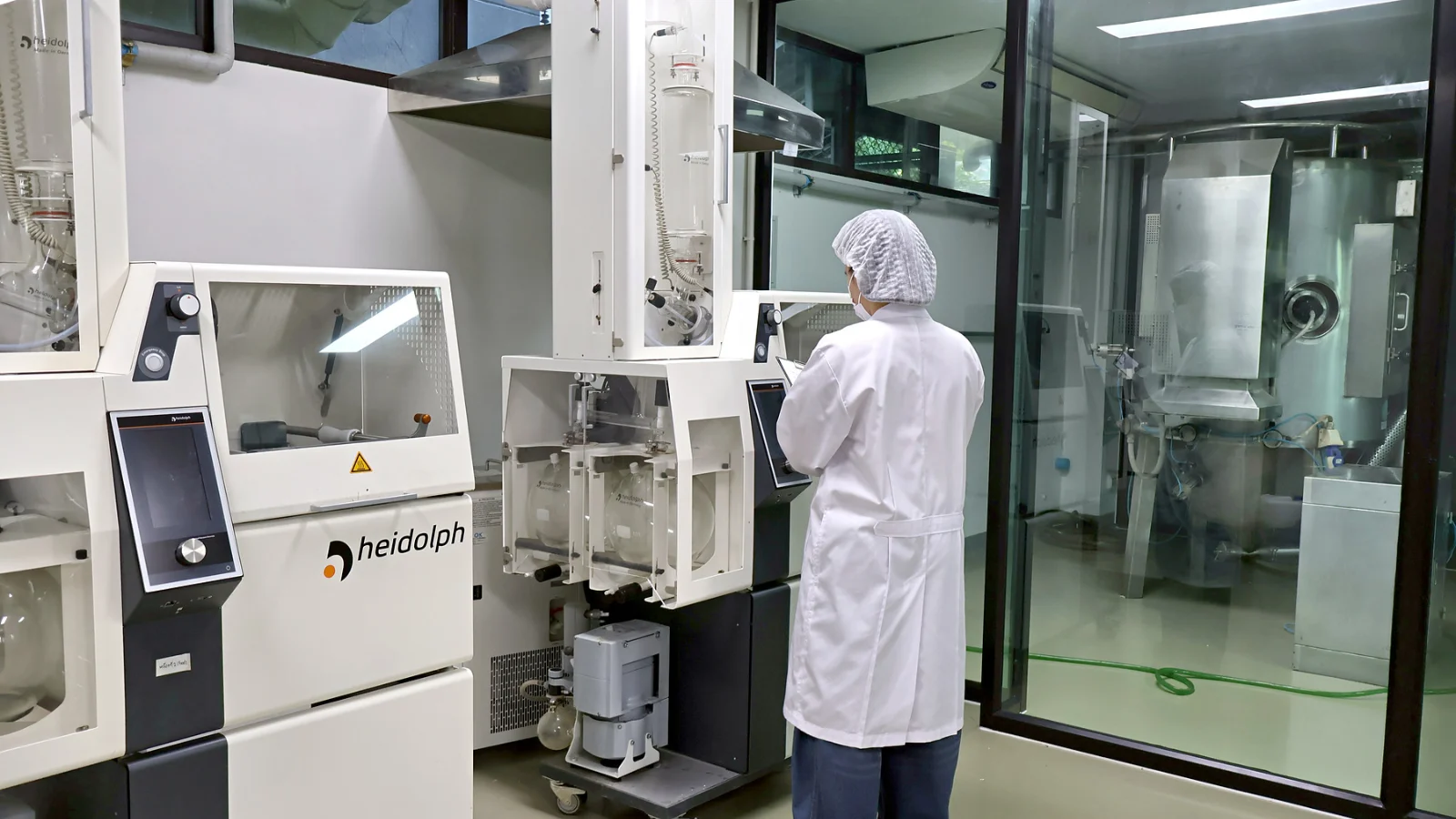
Own your raw material without owning a factory
A model still rarely used in Thailand, though the global market has used it for years
Most people are familiar with Original Equipment Manufacturer (OEM) in the context of finished goods: hiring a factory to make supplements or creams under your own brand.
But further upstream there is the same model that is still rarely used in Thailand: owning a raw material under your own name without owning a factory.
In the global ingredients market, many companies selling well-known extracts do not have their own factories. What they have is a proprietary specification, a trade name, supporting data and a customer network. Production is contracted out to capable manufacturers.
This model suits Thai entrepreneurs who know local plants, have a customer network or are strong in marketing, but do not want to invest tens of millions in a factory that will not run at full capacity.
How it differs from buying a standard extract
When you buy an extract from an ordinary supplier, you get a product that supplier will sell to anyone, to the same specification and at a similar price. Your competitors can buy the same thing on the same day.
When you use a private label service, four things are different.
The specification is yours You set the percentage of active compound, the marker compounds, the format and the properties you want, not what happens to be in stock.
The trade name is yours The extract is issued under the name you choose, with documents bearing that name, which is what builds recognition in the ingredients market.
The documents are yours The quality specification, Certificate of Analysis and technical documents are issued in your product’s name, so you can use them directly in submissions and in negotiations with buyers.
Exclusivity can be agreed We can agree not to produce the same specification for others within a defined scope, which buying a standard product cannot give you.
Who this service is for
People who already sell raw materials to manufacturers and want to move up from being a middleman who buys and resells to owning a product with its own specification and name, which changes both bargaining power and margins.
Brand owners who use large volumes of extract and want to control the quality and cost of their key raw material directly, instead of leaving it in the supplier’s hands.
People with distinctive local plants such as groups with their own plantations or local networks, who already have raw material others find hard to access and want to turn that advantage into a product.
Entrepreneurs about to export who want a product under their own name to build an identity in overseas markets.
What this service covers
Joint specification setting We start from the destination market where you will sell, then work back to define suitable marker compounds, percentage ranges, format and quality criteria, telling you what that market usually requires and which ranges are competitive.
Raw material sourcing through a controlled system with origin documents, or using raw material you source yourself.
Production to specification using a process designed to achieve the agreed values, with consistency controlled from lot to lot.
Quality control and documentation A Certificate of Analysis for each lot in your product’s name, together with the quality specification and technical data.
Packing as specified Pack sizes and labels as you require.
Documentation for the destination market Both documents for domestic regulatory submissions and documents for export.
Terms that should be agreed from the start
In our experience, relationships of this kind that fail usually fail because these points were not agreed in advance, so we raise them at the very first meeting.
Scope of exclusivity Whether the same specification will not be made for anyone at all, not for a particular territory, or not for a particular product category. Each option has different minimum quantity conditions, because broader exclusivity means more opportunities we give up.
Annual volume commitment This is the basis for planning raw material and production capacity, and it is what is exchanged for a better unit price.
Rights to the specification and data Who owns the specification developed together, and what each party can do if the relationship ends.
Handling out-of-specification results Whether to rework, reduce the price or not deliver should be agreed before a problem arises.
Trade secrets Covering the formula, the process and the list of your downstream customers.
What we will tell you plainly
This model is not for everyone
If you order small quantities and are not sure you will sell consistently, buying a ready-made extract on the market is more flexible and involves no commitment. We will tell you plainly if our assessment is that you have not yet reached the point where this model pays off.
And if what you want is the lowest price, this model is not the answer, because the unit price of an extract made to a proprietary specification is usually higher than that of a standard extract produced in large runs. What you pay extra for is differentiation and control, not savings.
What you need to prepare
The destination market where you will sell, your estimated annual usage, the specification you want or would like us to help define, the trade name you will use and a check that the name can be used, your exclusivity requirements, and a brief outline of your downstream customers so we can design a specification that matches what they will accept.
What you receive
Extract made to specification in your product’s name, a Certificate of Analysis for each lot in that name, a quality specification to attach to contracts with your downstream customers, technical documents for sales use, a document package for regulatory submissions and export, and a production plan that can be set in advance around raw material cycles.
An example of how to judge whether this model pays off
The decision whether to own your raw material or keep buying ready-made should be based on four questions.
Question one: are your volumes large enough yet? If annual volume is still small, the unit cost of producing to a proprietary specification will be so much higher than buying ready-made that it is not worthwhile.
Question two: does a different raw material really add value to your brand? For products consumers judge mainly on price, having a proprietary raw material may not let you charge more. But for products sold on story and credibility, this difference matters a great deal.
Question three: do you sell to buyers who value documentation and specifications? Corporate buyers and export markets value this; markets that trade on a one-off basis usually do not.
Question four: are you ready to commit to volumes in advance? Because exclusivity terms and a better unit price come in exchange for a volume commitment, which becomes a burden if sales fall short of expectations.
If you answer yes to three of the four, this model usually pays off. If you answer yes to only one or two, we recommend continuing to buy ready-made extracts for now and talking again once your volumes grow.
The path most clients take
From what we have seen, those who arrive at this model usually go through three stages first.
The first stage is buying a ready-made extract available on the market, using it in a product and seeing whether the market responds. The second stage is starting to define the specification you want yourself while still buying from ordinary suppliers, at which point you start to hit the limitation that nobody will make to your specification. The third stage is arriving at this model, once volumes are large enough and the difference has real value.
Jumping straight to this model before you know whether the market will respond is a risk we do not recommend.
Planning volumes and order cycles so the model actually works
The advantage of having your own proprietary extract turns into a burden immediately if volumes are planned wrongly. Unlike a standard extract that you can order at any time, an extract produced specifically for you needs production runs planned in advance and a minimum lot size that makes running the equipment worthwhile.
The starting point for planning is a realistic sales forecast, not a target. Many clients calculate volumes from the sales they hope for and end up with extract sitting in the warehouse until it expires. Conversely, overly cautious clients order too little, have to reorder often and lose the unit-cost advantage that was the reason for choosing this model in the first place.
What we do with clients is find a balance between three numbers. The first is the lot size that makes production worthwhile, which is set by the equipment and is not very flexible. The second is the shelf life of that extract, which determines how long you can store it before its quality starts to change. The third is the actual rate of use per month. With these three numbers, calculating the right order cycle becomes straightforward.
An approach that works in many cases is to produce one large lot in a single run, then store it in portions and carry out final processing in stages as needed. This gives the production cost of a large lot with the freshness of product on the cycle you actually use. It suits compounds whose intermediate keeps for a long time but whose final form has a short shelf life.
Another point that should be agreed from the start is what happens if you order much less than forecast, or stop ordering altogether, because we have to source raw material in advance according to the agreed plan. Writing these terms fairly for both parties keeps the long-term relationship on track when your business changes direction, which can always happen and is nobody’s fault.
Frequently asked questions (FAQ)
Q: What is the minimum quantity?
A: There is both a minimum per run and an annual volume condition where exclusivity is required. The figures vary by compound and by the scope of exclusivity requested. We will let you know with the quotation.
Q: Will Zubb Biotech sell the same ingredient to competitors?
A: It depends on the terms agreed. If you want exclusivity, we set out the scope clearly in the contract and adhere to it strictly, because credibility on this point is the only thing that makes this model work.
Q: Can we use our own raw material?
A: Yes, and it is the arrangement chosen by clients who have plantations or farmer networks. The raw material must first pass incoming inspection against set criteria, because that determines what the documents we issue can certify.
Q: In whose name will the documents be issued?
A: In your product’s name, stating the actual place of manufacture, which is an unavoidable legal requirement and something corporate buyers will check anyway.
Q: Can we start with a small lot first?
A: Yes. We recommend starting with a trial lot to confirm that the agreed specification can actually be achieved and that the market responds, before signing a long-term commitment.
Q: Is it cheaper than buying a standard extract?
A: Generally not, because it is production to a proprietary specification that does not benefit from large production runs. What you get is differentiation and control, which should be assessed by its impact on your selling price and the sustainability of your business, not by cost per kilogram alone.
Next step
Tell us which market you sell to, how much you use per year and what kind of specification you want, at [email protected] or LINE @zubbbiotech. We will assess feasibility, propose a suitable partnership structure, and tell you plainly if our assessment is that you have not yet reached the point where this model pays off.
Contact us and request a quotation
Send us the details of your project via Contact us or LINE @zubbbiotech · Tel. +66 89 056 5651 · +66 97 297 1777 · Email [email protected]