

Regulatory & Export Documentation Service
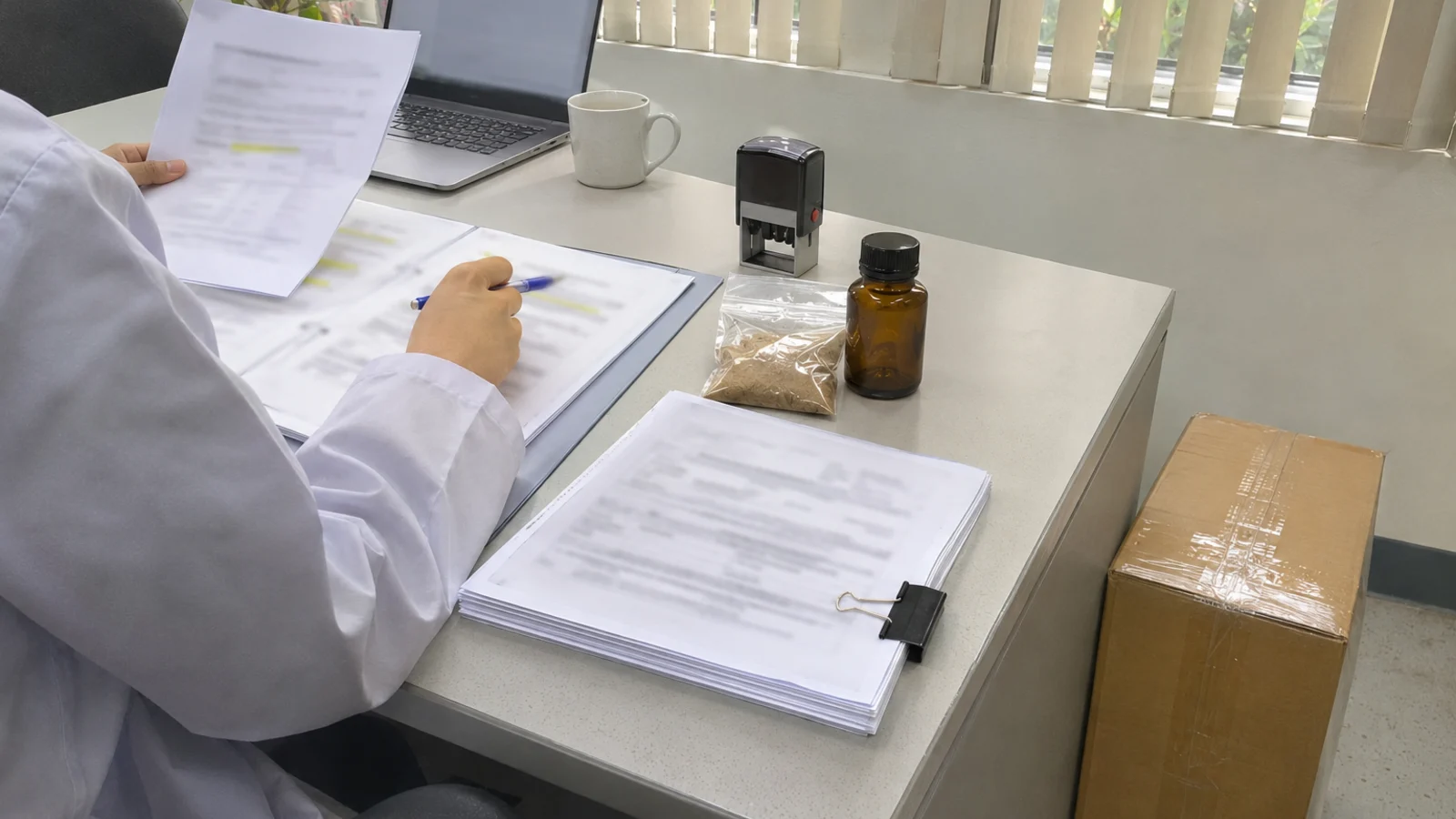
Work that cannot be done retrospectively
Projects do not stall at production. They stall at documentation
From the work we have done with clients, what delays projects most is not production, and not formula development.
What causes delays is the document submission stage, and the most common reason is that the brand owner has prepared the product-side documents in full but lacks the raw material-side documents, which have to be obtained from the facility that produced the extract.
The bigger problem is that some raw material documents require data to be collected during production and cannot be prepared retrospectively. Once the gap is discovered, there are usually only two options left: reproduce the whole lot, or wait for the next production run and collect the data properly. Both mean losing several months.
This service takes care of the raw material-side documentation from the start, so that when you are ready to submit, the documents are ready too.
Note: Regulatory criteria are updated from time to time. We check the latest version before preparing every document set, and recommend confirming with your legal adviser before actual submission.
Route 1: Dietary supplements
This is the route most of our clients use, because it is the main destination for herbal extracts in the Thai market.
The raw material documents to prepare include a raw material quality specification stating the scientific name, plant part used, extraction ratio and acceptance criteria; the analysis report for the lot actually used; a brief description of the raw material manufacturing process, including the solvents used; safety data on the substance with scientific references; and certification of the raw material manufacturing site.
The common pitfall on this route is choosing a plant that is not on the list permitted for use in dietary supplements, or one listed with quantity conditions attached (Notification of the Ministry of Public Health (No. 293) B.E. 2548, 2006). This must be checked before ordering production, not after the material has arrived, and we check it at the assessment stage at no extra charge.
Route 2: Cosmetics
This route takes less time, but has stricter labelling details than many people expect.

What needs to be prepared is the internationally recognised ingredient name used on the ingredient label, the analysis report for the lot used, safety data on the substance, and information on the solvent system or carrier blended into the extract.
The common pitfall is forgetting that a carrier added when converting the extract to powder must also appear on the label, and that an extract containing a solvent must be declared accurately. Many brands list only the plant name and later find that the label is incomplete under the law (Cosmetic Act B.E. 2558, 2015).
If the product will be sold in ASEAN, the region’s common requirements must also be considered, which include lists of prohibited substances and substances permitted under conditions (Association of Southeast Asian Nations, 2003).
Route 3: Herbal products
This is the strictest route in terms of raw material documentation, and the one where businesses most often underestimate the time required.
What needs to be prepared is a raw material quality specification based on a citable standard text, which for many Thai herbs is already set out in the Thai Herbal Pharmacopoeia (Department of Medical Sciences, 2021); a full set of analysis results including heavy metals, microorganisms and contaminants; information on the raw material’s origin and quality control from the field onwards; and supporting data on safety and use within the specific legal framework (Herbal Products Act B.E. 2562, 2019).
Additional document set for export
If you plan to sell overseas, prepare from the start, because some documents require data collected during production and cannot be prepared retrospectively.
This set includes a safety data sheet for the substance; a certificate of free sale in the country of manufacture; a certificate confirming no animal-derived ingredients, or halal documentation, as the destination market requires; traceability data back to the growing source; and pesticide and mycotoxin test results, which many buyers set as a standard condition (Codex Alimentarius Commission, 1995; World Health Organization, 2007).
What many Thai businesses do not know is that some plants fall under requirements for documentation confirming access to and benefit-sharing from biological resources, which European importers often ask to see before agreeing to buy (Secretariat of the Convention on Biological Diversity, 2011). Not having this documentation can end a deal midway, even when the product is excellent in every other respect.
The timeline to follow
This is the sequence we recommend every project follows, because each step has points that cannot be reversed.

Step 1: Before ordering production Check the legal status of the plant to be used: whether it can be used in that product type, whether there are quantity conditions, and whether additional permits are required.
Step 2: Before production starts Agree the raw material quality specification in writing, because this document will serve as the receiving criteria and as an attachment to the submission.
Step 3: When ordering production Specify all required tests on the Certificate of Analysis (COA), including those that will be needed for future export, because adding them later means testing retained samples, which may not be sufficient.
Step 4: While waiting for production Compile the raw material documents and check completeness against the checklist.
Step 5: When documents on both sides are complete submit the application.
What you need to prepare
The destination product type, because the documentation routes differ clearly from the outset; the markets you will sell in, both domestic and overseas; any requirements sent by your buyer or importer; and the submission deadline, so we can plan backwards which step must start when.
If you already work with a legal consultant or a supplement contract manufacturer, let us know. We can coordinate with your team and will not duplicate work they are already handling.
What you will receive
A raw material document set arranged according to the list required by the authority or buyer, together with a checklist stating clearly which documents we issue and which you need to obtain yourself, which clients say is the most useful document, because it shows the whole picture on one page and makes clear whom to follow up with.

You will also receive a timeline working back from the submission date, and recommendations on additional items to prepare if you plan to expand into new markets in future, so you do not have to reproduce when the opportunity arrives.
The five most common documentation mistakes
From past work, the documentation problems that delay projects tend to repeat a handful of themes, and almost all of them can be prevented if known from the start.
First, the raw material name does not match across documents. The analysis report uses the trade name, the certificate of origin uses the Thai name, and the application form uses the scientific name. The reviewing officer has no way of knowing they are the same thing, and the application will be returned for clarification. The prevention is to set a single standard name from day one, use it on every document, and always include the scientific name alongside it.
Second, the analysis results come from a different lot from the product to be sold. This happens when the team rushes to submit using results from a trial lot, and then the real production is a different lot. The fix is to plan for the submission lot to be one produced by the same process that will be used in real production, even if it takes two or three weeks longer.
Third, the tests do not cover everything the notification requires, especially the items the law specifies for food in hermetically sealed containers, which differ from the tests manufacturers are used to running routinely. Reading the relevant notifications in full before ordering tests saves far more time than running extra tests later.
Fourth, label wording strays into health claims that require supporting evidence. The marketing team writes copy that sells, then sends it to the legal team as the final step, which is often too late because the packaging has already gone to print. The right order is for the legal team to set the boundaries first and for the marketing team to write within them.
Fifth, export-market documents are prepared late, even though many items must be obtained during production, such as documents confirming the plant’s origin and documents relating to access to biological resources. Going back to prepare these documents after production is finished is very difficult, and in some cases impossible.
Frequently asked questions (FAQ)
Q: Does Zubb Biotech issue every document?
A: We issue the documents relating to our raw material and manufacturing process. Documents for the finished product are the responsibility of the product manufacturer. We state clearly in the checklist who is responsible for what, so there is no gap where each side assumes the other is handling it.
Q: Can I request documents retrospectively for a lot I have already bought?
A: Only for tests carried out at the time of production. Anything not tested then must be tested from retained samples, which takes extra time and may be limited by how much sample remains.
Q: Can you submit on my behalf?
A: We prepare and compile the raw material-side documents. Submission in the product’s name is the right and duty of the applicant, and we can coordinate with your consultant throughout the process.
Q: Can I use this service if I buy my extract from another manufacturer?
A: Yes, to the extent that the information from that manufacturer allows. We help check whether the documents you have are complete and identify what you need to request from the manufacturer, a service many clients use before deciding whether to switch manufacturers.
Q: Is it worth preparing export documents in advance when I do not yet have overseas customers?
A: It is worth it only for items that require data collected during production, because those cannot be prepared retrospectively. Documents that can be obtained later need not be rushed. We separate these clearly in the checklist so you do not pay in advance more than necessary.
Q: How long does it take?
A: The compilation and preparation phase has a clear timeframe, which we state in the quotation. If additional tests are needed, the testing time is counted separately.
Next step
Tell us the product type and the market you will sell in at [email protected] or LINE @zubbbiotech. We will send you a raw material document checklist and a backward timeline as soon as possible. If you are not yet sure which route your product falls under, send us the product details for assessment.
Contact us and request a quotation
Send us the details of your project via Contact us or LINE @zubbbiotech · Tel. +66 89 056 5651 · +66 97 297 1777 · Email [email protected]
References
- Department of Medical Sciences. (2021). Thai herbal pharmacopoeia 2021 . Bureau of Drug and Narcotic, Department of Medical Sciences.
- Notification of the Ministry of Public Health (No. 293) B.E. 2548 Re: Dietary supplements, as amended. (2006, February 2). Royal Thai Government Gazette, 123(Special Part 18 Ngor).
- Herbal Products Act B.E. 2562. (2019, April 30). Royal Thai Government Gazette, 136(Part 56 Kor), 1–29.
- Cosmetic Act B.E. 2558. (2015, September 8). Royal Thai Government Gazette, 132(Part 86 Kor), 5–28.
- Association of Southeast Asian Nations. (2003). ASEAN cosmetic directive. ASEAN Secretariat.
- Codex Alimentarius Commission. (1995). General standard for contaminants and toxins in food and feed (CXS 193-1995). Food and Agriculture Organization of the United Nations & World Health Organization.
- Secretariat of the Convention on Biological Diversity. (2011). Nagoya Protocol on access to genetic resources and the fair and equitable sharing of benefits arising from their utilization to the Convention on Biological Diversity. United Nations.
- World Health Organization. (2007). WHO guidelines for assessing quality of herbal medicines with reference to contaminants and residues.